

Events
Events
Class passes now available!
Members now have access to our Astronomy Class Pass! Buy a 6-month or year-long class to gain unlimited access to our ongoing class series for the specified time period! Use the pass to attend classes in person or to receive class recordings when you can't make it to the observatory! Check out our 2026 Astronomy Class Schedule
For most of the 20th century, astronomers assumed the universe's expansion was slowing down under its own gravity. Then in 1998, observations of distant supernovae revealed something nobody expected: the expansion is speeding up. Join us as we trace how that discovery was made, meet the mysterious force behind it, and explore why "dark energy" — despite making up roughly 68% of everything in existence — remains one of the biggest unsolved puzzles in modern physics. No equations required, just a healthy sense of cosmic mystery.
Class level: Introductory - This class is recommended for guests of any background.
Tickets:
Non-members $25/class
Members $20/class
Student (with valid ID) $10/class
Image credit: NASA
.png)
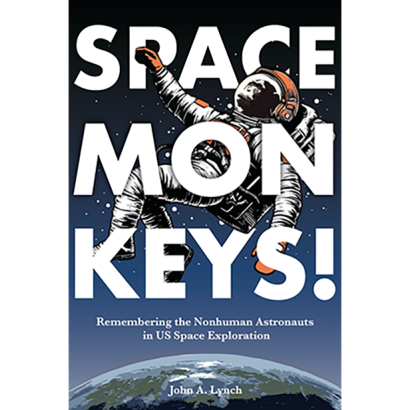
Trained, Treasured, Tragic: The American Primates Behind the Space Race
Guest Presenter: John Lynch, Ph.D.
Before Alan Shepard and John Glenn flew into space, the United States had other astronauts named Able, Baker, Ham, and Enos. They weren’t human. They were monkeys and chimpanzees the United States used to research space medicine and to make sure humans could safely leave the Earth’s atmosphere. Learn about the space monkeys and about how they are memorialized in books, films, and museums around the country!
Presenter Bio: John Lynch is a professor at the University of Cincinnati in the School of Communication, Film, and Media Studies. He is a 2026-2027 fellow at the Niehoff Center for Film and Media Studies, an affiliate of UC’s Center for the Public Engagement with Science, a consultant for the Smithsonian Science Center’s Biotechnology education guide, and a member of the Smithsonian Science Education Center’s inaugural Science Ambassador cohort. He’s an award-winning author and editor of four books and over 60 articles. His work focuses on the communication dynamics and ethical entailments of medical, scientific, and technical communication. His first book—What are Stem Cells? Definition at the Intersection of Science and Politics—won the 2016 National Communication Association’s Health Communication Distinguished Book Award. His second book—Origins of Bioethics: Remembering When Medicine Went Wrong—received the Association for the Rhetoric of Science and Technology 2020 Book of the Year Award.
Class level: Introductory - This class is recommended for guests of any background.
Tickets:
Non-members $20/class
Members $15/class
Student (with valid ID) $10/class
Image credit: University of Alabama Press
Ghosts, Ghouls, and Galaxies: A Halloween Sky Tour
The October sky has more than just crisp air and falling leaves to offer — it's home to some genuinely spooky sights, from the eerie glow of the Ghost Nebula to the shadowy Witch Head. Join us for a seasonal tour of fall's most hauntingly beautiful deep-sky objects, paired with the myths and legends that gave many of them their names. Bring your curiosity (and maybe a costume) as we hunt for cosmic phantoms hiding in plain sight overhead. Perfect for anyone looking to get into the Halloween spirit while learning to navigate the autumn sky.
Class level: Introductory - This class is recommended for guests of any background.
Tickets:
Non-members $25/class
Members $20/class
Student (with valid ID) $10/class
Image credit: NASA
.jpg)